 Persian Music Scales
Al-Urmawī Advar Atlas
An interactive reconstruction of the interval ratios, fret positions and modal cycles described in Ṣafī al-Dīn al-Urmawī’s Book of Cycles.
Reading the Book of Cycles
In the thirteenth century, al-Urmawī described interval divisions and ways of combining them into cycles in the Kitāb al-Adwār. A copy of the treatise survives as British Library Or 136. The catalogue and folios in the Qatar Digital Library let readers move from the modern diagram to a manuscript witness.
One string, two ratios
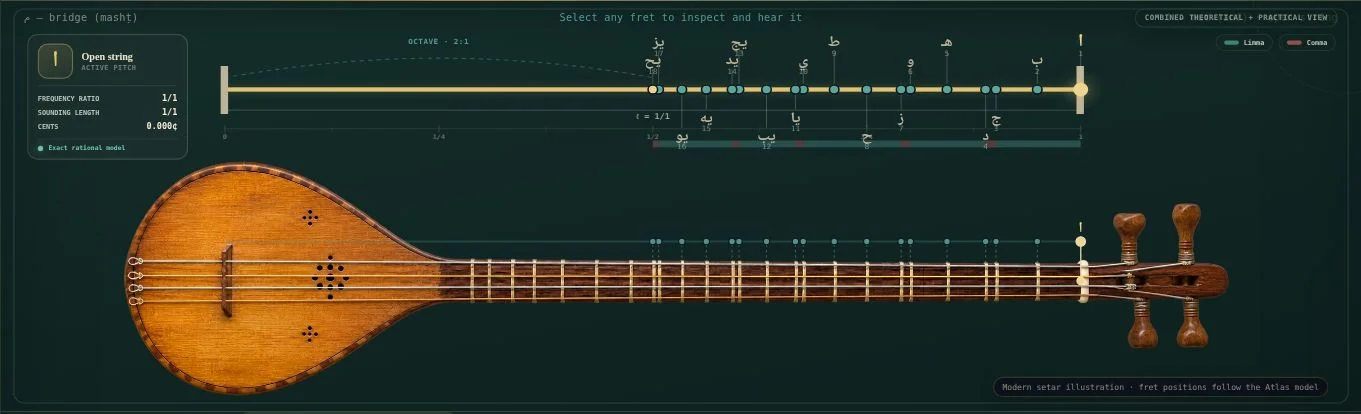
Choose a position in Explore. With the string material and tension held constant, a sounding length of three quarters gives a frequency of four thirds of the open string. Listen to the two pitches, then compare the pure tone with the plucked model. The pitch relationship stays the same as the timbre changes.
Building a fourth
The model includes a tetrachord with two whole tones of 9/8 and a limma of 256/243. Multiplying the three ratios gives 4/3, a fourth. On the Atlas monochord the seventeen steps of the octave have unequal sizes. Construct shows one pedagogical sequence for locating the divisions.
From an interval to a mode
Species & Modes lets you compare orders of intervals. A medieval cycle and a present-day dastgah can share a name while differing in their musical organization. Kioumars Poorhaydari’s study of Iṣfahān follows this problem across treatises and radifs.